Trail of Tears (Drane Overland Route)
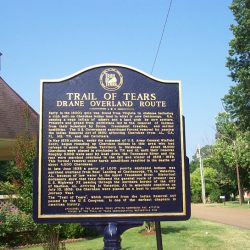
TRAIL OF TEARS / DRANE OVERLAND ROUTE
Early in the 1800’s gold was found from Virginia to Alabama including a rich belt on Cherokee Indian land in what is now Dahlonega, GA, causing a huge influx of miners and a land grab by new settlers. Pressure and greed from politicians led to the removal of Indians from their homeland by force, fraudulent treaties, and settler hostilities. The U.S. Government sanctioned forced removal by passing The Indian Removal Act of 1830 affecting Cherokee from AL, GA, FL, MS, TN, and the Carolinas. In May 1838 soldiers, under the command of U.S. Army General Winfield Scott, began rounding up Cherokee Indians in this area who had refused to move to Indian Territory in Oklahoma. About 16,000 Cherokees were placed in stockades in TN and AL until their removal. Roughly 3,000 were sent by boat down the Tennessee River and the rest were marched overland in the fall and winter of 1838-1839. This forced-removal under harsh conditions resulted in the deaths of about 4,000 Cherokees.
In late June 1838 a party of 1,070 poorly equipped Indians was marched overland from Ross’ Landing at Chattanooga, TN, to Waterloo, AL, because of low water in the upper Tennessee River. Historical documents show that they followed the general route of present-day U.S. Highway 72 passing through the northern border of the city of Madison, AL. Arriving in Waterloo, AL in miserable condition on July 10, 1838, the Cherokee were placed on a boat to continue their journey West.
The “Trail of Tears”, which resulted from The Indian Removal Act passed by U.S. Congress, is one of the darkest chapters in American history.
Sponsored by the Alabama Indian Affairs Commission and Attotca
Funded by the Trail of Tears Commemorative Motorcycle Ride